What Does a Swallow Tattoo Mean?
Learn the documented sailor history of swallow tattoos and how travel, homecoming, loyalty, and personal meaning can shape a design.
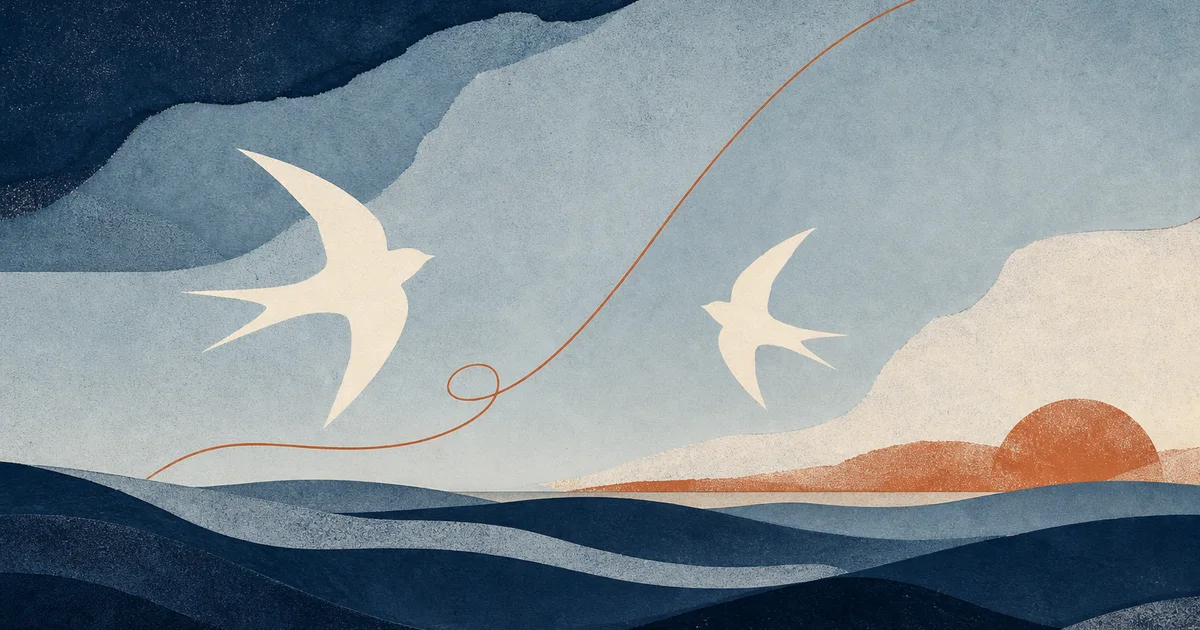
A swallow tattoo is strongly associated with sailors and long journeys. In a documented U.S. naval tradition, a swallow could represent 5,000 nautical miles traveled. Today, people also choose swallows for return, home, loyalty, love, freedom, remembrance, or a journey of their own.
No bird count, direction, or pose assigns one universal meaning. Historical context can explain a tradition; the wearer decides the personal message.
The documented sailor connection
Swallows became part of a broader visual language used by sailors to mark experience, identity, places, and events.
The U.S. Naval History and Heritage Command records that renditions of a swallow originally indicated 5,000 nautical miles underway. Its overview also warns that the poses and combinations of naval tattoos can vary. Read the U.S. naval history overview.
The National WWII Museum gives the same 5,000-mile association in its account of wartime tattoo traditions. Read the museum article.
These sources support a specific maritime meaning in a U.S. and Western naval context. They do not establish that every swallow tattoo in every country or period was earned in the same way.
Why 5,000 nautical miles appears in tattoo history
A nautical mile is based on navigation rather than an ordinary road mile. Five thousand nautical miles represented substantial time and distance at sea. A swallow could therefore act as a compact record of experience.
That mileage meaning is more specific than the broad idea of “travel.” If you are describing tattoo history, retain the maritime context. If you are planning a personal tattoo about a road trip, migration, or a return home, it is better to call that your interpretation than to claim a naval achievement you did not intend.
Documented tradition and personal interpretation
| Layer | Possible reading | Best way to describe it |
|---|---|---|
| Documented naval tradition | Miles traveled at sea; sailor experience | Name the naval source and context |
| Broad modern association | Journey, movement, freedom, or return | Use “can represent,” not “always means” |
| Relationship | Loyalty, love, or connection across distance | Explain the wearer’s chosen link |
| Memorial meaning | Remembering a person, place, or shared journey | Treat it as personal unless a source documents a specific tradition |
| Visual choice | One or two birds, direction, banner, flower, color | Use as composition, not a universal symbolic code |
This prevents a common research mistake: placing a sourced mileage tradition and an unsourced pose rule in the same list as though they had equal evidence.
Homecoming, travel, loyalty, and remembrance
Homecoming
Swallows are migratory birds, so people often connect them with departure and return. In a tattoo, that can stand for a home, a person, or the wish to find a way back. It is a clear modern interpretation, but not every homecoming story found online is a documented sailor rule.
Travel
Travel is the closest broad extension of the nautical-mile tradition. A wearer may mark a major route, a life between places, or movement as part of their identity.
Loyalty and love
Paired birds can make a relationship visually central. The association may come from the wearer’s understanding of swallows, a shared image, or the composition itself. It should not be presented as a biological rule or a meaning that every pair of swallows carries.
Remembrance
A swallow can carry the memory of someone connected to the sea, a journey, or a return that matters. A date, initial, route line, or specific color may make that context more personal. Without those details—or the wearer’s explanation—an observer cannot know.
Does one swallow or two swallows change the meaning?
It can change the composition and the meaning chosen by the wearer, but there is no universal equation.
One swallow creates a clear focal point and may suit independence or one specific journey. Two can create symmetry, movement between two points, or a relationship. More birds may feel like a group, sequence, or migration.
Treat those as design possibilities. Do not tell a client that two birds must mean a particular mileage, relationship status, or event unless the relevant historical source or the client’s own story supports it.
Does the direction of a swallow matter?
Direction matters visually. A bird can fly into the body’s movement, toward another element, upward through a long placement, or around an arm or leg.
Online guides sometimes assign fixed meanings to a swallow facing left, right, inward, or outward. The reliable naval sources above emphasize that poses and combinations vary, so direction should begin with composition and the wearer’s intention rather than an assumed code.
Build an evidence-aware swallow tattoo brief
Use four lines to connect history with your own idea:
Documented reference:
The sailor association with long distance at sea.

My personal intention:
Returning to the coastal town where my family lives.

Visible elements:
One swallow moving toward a simple horizon line; no banner or text.

Open to the artist:
Wing position, exact direction, line weight, background, and final scale.
Then add placement, approximate measured size, and color direction. A swallow with readable feathers may need more space than a minimal silhouette. The placement and size guide helps turn Small, Medium, or Large planning categories into a real artist discussion.
From symbolism to an artist conversation
AI Tattoo Design can help you test concept, style, placement, size, and color direction. It cannot produce authentic historical flash or certify that a symbol has one traditional meaning.
If you explore a private swallow concept, label it as an AI-generated reference. Do not ask an artist to copy archival flash or another artist’s portfolio. Use the tattoo artist brief template and invite the artist to redraw the bird, flight path, and surrounding elements for the body.