What Does a Semicolon Tattoo Mean?
Explore the documented history and common meanings of a semicolon tattoo without treating the symbol as a diagnosis or a universal story.
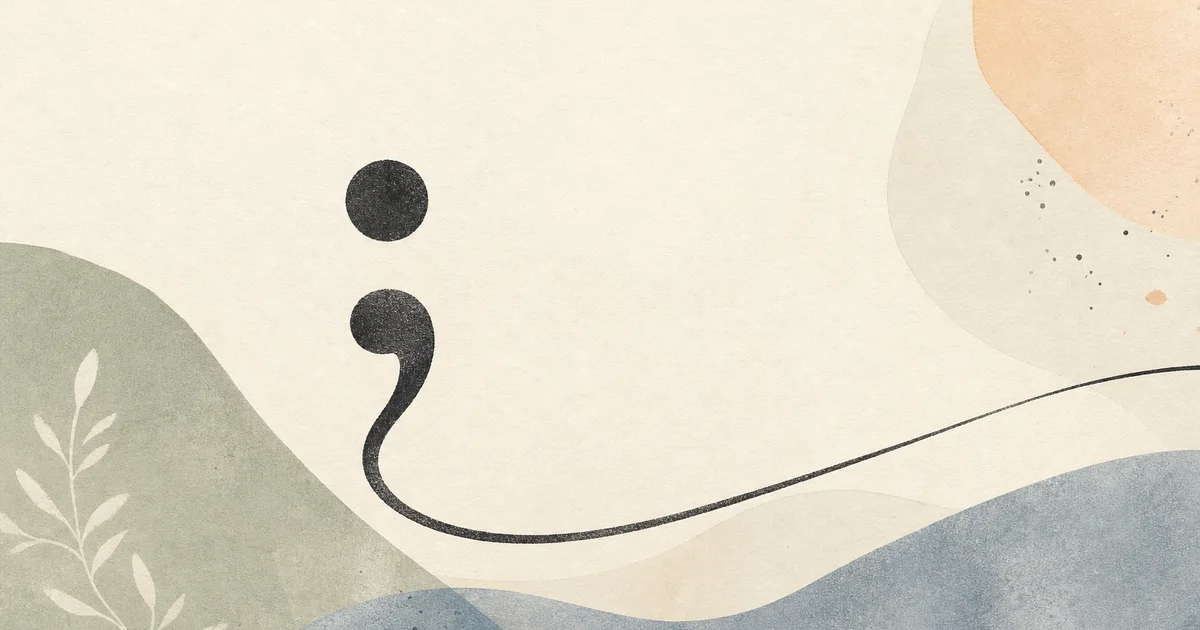
A semicolon tattoo is commonly associated with continuation: a life or story that could have ended but continues. Its best-known public connection is Project Semicolon, a mental-health awareness movement that began in 2013.
People may choose the symbol for personal recovery, remembrance, solidarity, hope, or another private reason. The tattoo alone does not reveal a diagnosis, a suicide attempt, self-harm, or any other part of a person’s medical history.
The documented history of Project Semicolon
Project Semicolon records that Amy Bleuel began the movement in spring 2013 while honoring her father, whom she had lost to suicide. The organization connected the punctuation mark with people affected by depression, addiction, self-injury, and suicide. Read Project Semicolon’s history.
The writing metaphor made the mark memorable. In a sentence, a writer uses a semicolon where the thought could have stopped but instead continues. Project Semicolon applied that idea to a continuing life story. See the organization’s explanation of the tattoo.
This is the documented history of a particular campaign and its public use of the symbol. It is not proof that every semicolon tattoo belongs to the movement, and it does not give one organization control over every personal interpretation.
Why the semicolon became a symbol of continuation
The symbol is visually small but conceptually active: it acknowledges a pause without making the pause an ending. That can make it meaningful to someone who wants to mark endurance, a decision to continue, or support for another person.
Mental-health organizations have published individual stories in which semicolon tattoos carry remembrance and continuing-story meanings. For example, an American Foundation for Suicide Prevention story and a NAMI personal story show how particular people have explained their own marks.
Those accounts are examples, not a codebook. A personal narrative can show what a tattoo means to its wearer; it cannot establish what the same symbol means on someone else.
Four layers of semicolon tattoo meaning
Separating four layers prevents a common meaning from turning into a personal assumption.
| Layer | What it can tell you | What it cannot tell you |
|---|---|---|
| Documented history | Project Semicolon used the mark in a public mental-health movement beginning in 2013 | Whether a particular wearer participated in that movement |
| Common association | Many people recognize continuation, hope, remembrance, or solidarity | A wearer’s diagnosis or life event |
| Personal meaning | The meaning the wearer explicitly gives it | A meaning that observers may assign without asking |
| Added design elements | Flowers, birds, words, dates, or lines may add visible themes | One guaranteed interpretation shared by everyone |
The fourth layer is especially easy to overread. A flower may be connected to a person, a season, an aesthetic preference, or nothing symbolic at all. Visible detail can invite a question, but it cannot answer that question on the wearer’s behalf.
Common meanings are not personal diagnoses
It is fair to say that semicolon tattoos are widely associated with mental-health awareness and suicide prevention. It is not fair to identify a stranger as depressed, a survivor, bereaved, or in recovery because of a tattoo.
Use language such as:
- “The symbol is commonly associated with continuation.”
- “Some people use it to mark a personal experience.”
- “Its meaning depends on the wearer.”
Avoid:
- “This proves the wearer survived…”
- “People with this tattoo have…”
- “A semicolon always means…”
This distinction respects both people who chose the tattoo through Project Semicolon and people whose reasons are different or private.
How added elements can change the message
A semicolon can remain plain or become part of a larger composition. When planning one, start with intention rather than a list of supposed symbol definitions.
A line or path
A continuous line can reinforce movement or an unfinished journey. Decide whether you want the punctuation to remain immediately legible or emerge only after a closer look.
A flower or plant
Botanical elements can bring growth, remembrance, season, place, or simply a visual shape. Name the reason you chose the plant instead of relying on a generic flower-meaning list.
A bird or wing
Flight can suggest movement, freedom, distance, or a particular memory. It does not automatically change the semicolon into a single new meaning.
A word, initial, or date
Text can make the personal context more explicit, but small lettering and dates need careful scale and spacing. A tattoo artist should decide what remains readable at the intended size.
How to plan a respectful semicolon tattoo
Write a brief that separates what matters from what can change:
Intention:
Continuation and support, expressed quietly.

Must keep:
A clearly readable semicolon and one unbroken line.

Open to changing:
Line path, proportions, orientation, and surrounding negative space.

Placement and visibility:
[Body area] and [whether I want it private, visible, or easy to cover].

Approximate size:
[Measured height × width range].

Color direction:
[Black and grey or a limited color direction].
Visibility can matter as much as style. The tattoo placement and size guide can help you think through orientation and measured space. The final line weight, spacing, and stencil belong with your tattoo artist.
If this subject feels immediate
A tattoo article cannot assess someone’s safety or provide crisis care. If you or another person may be in immediate danger, contact emergency or crisis support in the person’s location now. Use an official health authority in that country or region to find the current service.
Turn personal intention into a visual brief
AI Tattoo Design can help you explore a private concept using concept, style, placement, size, and color mode. It cannot determine your mental-health story, provide support, or certify what the symbol means.
After the important personal and safety questions are settled, you can explore a visual direction. Label the result as an AI-generated concept and use the tattoo artist brief template to ask an artist to redraw it for your body and their practice.