What Does a Medusa Tattoo Mean?
Explore Medusa tattoo meanings through classical art, protective imagery, modern interpretations, and the wearer’s own intent.
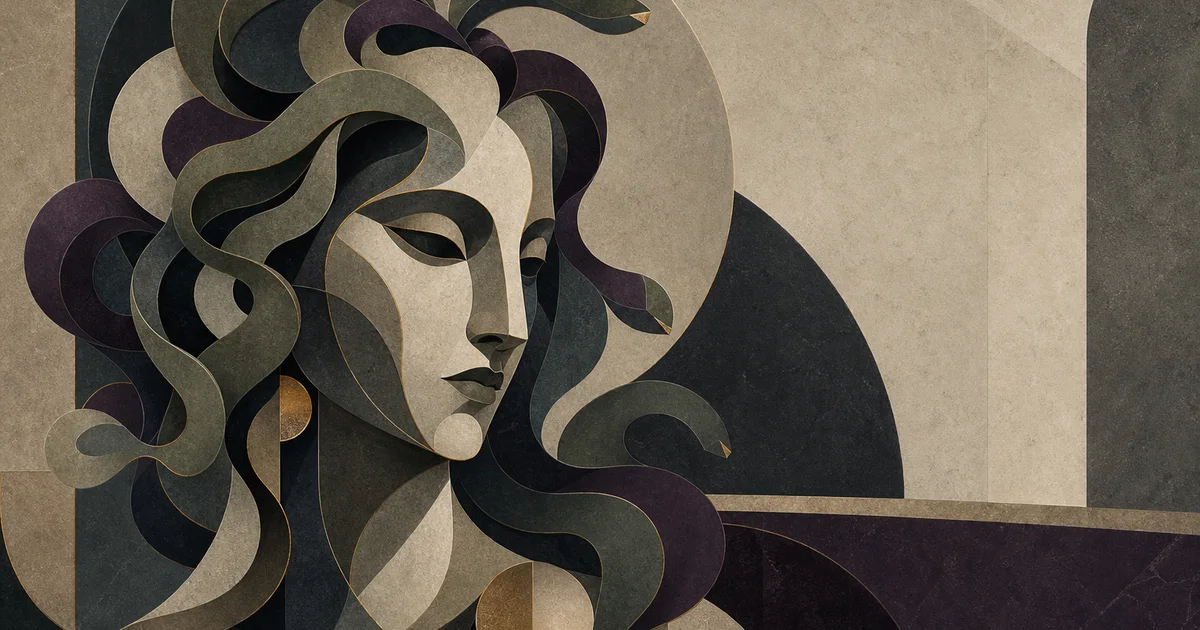
A Medusa tattoo can represent protection, dangerous power, transformation, defiance, or a personal experience of survival. Those meanings come from different layers of history and modern culture; they are not one universal definition.
In ancient art, Medusa’s face could work as a protective image meant to ward off harm. In contemporary tattooing, some people—including some survivors of sexual violence—have chosen Medusa for their own accounts of visibility and survival. You should never infer that history from a stranger’s tattoo.
Medusa in classical story and ancient art
Medusa is one of the Gorgons in Greek myth. Ancient stories and images do not form a single, unchanged biography. Her appearance, family, mortality, and encounter with Perseus are treated in different ways across sources and periods.
That variation matters. A short online explanation often selects one later story and presents it as the only “original” meaning. A tattoo, meanwhile, may draw from the monster, the woman, the severed head, the protective face, later art, or a modern reinterpretation.
The Metropolitan Museum of Art traces Medusa’s changing visual form and explains that the Gorgoneion—the frontal face or head of a Gorgon—was widely used as an apotropaic image. In plain language, it was intended to turn away or repel harmful forces. Read The Met’s art-history essay.
The protective Gorgoneion
Ancient Gorgoneia appeared on objects, architecture, armor, vessels, and other surfaces. Their frightening force could be protective: an image of danger used against danger.
The British Museum, for example, describes the Gorgoneion on one ancient object as having apotropaic powers. See the museum object record.
This supports protection as a historically grounded Medusa association. It does not prove that every ancient image had exactly the same use, or that a modern wearer chose a Medusa tattoo for that reason.
How later art changed Medusa’s image
Medusa has not always looked the same. Ancient depictions could be deliberately monstrous, while later works often made her more human, beautiful, tragic, or psychologically complex.
The Met’s exhibition publication Dangerous Beauty: Medusa in Classical Art shows why it is misleading to collapse centuries of visual reception into one symbol dictionary entry.
A contemporary tattoo may consciously combine layers: a calm human face with threatening snakes, a stone-like portrait with living movement, or an image that is both guarded and vulnerable.
Four layers of Medusa tattoo meaning
| Meaning layer | What the evidence can support | What it cannot prove |
|---|---|---|
| Classical story | Medusa belongs to a varied Greek mythic tradition involving Gorgons and Perseus | One single “original” moral for every version |
| Ancient image | The Gorgoneion often served a protective, warding function | The intent of every ancient object or modern tattoo |
| Later reception | Artists repeatedly changed Medusa’s appearance and emphasis | A universal modern meaning |
| Personal tattoo | A wearer may choose protection, power, anger, transformation, beauty, survival, or another reason | The wearer’s history without their own explanation |
This structure lets apparently conflicting explanations coexist. Protection is not the same claim as survival; an ancient object is not evidence of a modern social trend; a personal tattoo is not a public diagnosis.
Modern Medusa tattoo meanings
Protection and boundaries
The apotropaic history gives protection a strong connection to earlier visual culture. A modern wearer may use Medusa as a guardian, a warning, or a sign of personal boundaries.
Power and defiance
Medusa can embody force that cannot be looked at safely. In modern readings, that can become refusal, anger, self-possession, or resistance to being made harmless.
Transformation and complexity
Snake, stone, gaze, beauty, and danger create a visual language of change. Some people value that tension without assigning the tattoo one literal life event.
Survival
A 2026 peer-reviewed study examines how some survivors of sexual violence use Medusa tattoos in relation to visibility, survival, and traumatic experience. Read the study.
That research documents a real contemporary use. It does not turn a Medusa tattoo into a universal survivor symbol or allow an observer to infer sexual violence. Use “some survivors have used” rather than “a Medusa tattoo means the wearer was assaulted.”
Does a Medusa tattoo on a woman have a special meaning?
Not automatically. The wearer’s gender does not assign one meaning to the design.
A woman may choose Medusa for any of the historical, aesthetic, or personal reasons above. The same is true for a wearer of any gender. If the meaning is relevant and the person wants to share it, ask respectfully instead of decoding their body.
How design choices affect the reading
Start with the layer you intend, then decide which visible choices support it:
- Expression: guarded, confrontational, calm, grieving, or unreadable
- Gaze: direct, averted, covered, or shown in profile
- Snakes: dominant silhouette, quiet frame, movement, or dense texture
- Treatment: stone-like, graphic, fine-line, blackwork, or colorful
- Surrounding elements: shield-like frame, broken shapes, plants, stars, or open negative space
These are composition choices, not a fixed code. A covered eye does not carry one guaranteed meaning, and adding a flower does not make the tattoo universally “feminine.”
Write a respectful Medusa tattoo brief
Use the meaning layers to make your intention explicit:
Primary intention:
Protection and firm boundaries, not a literal myth scene.

Must keep:
One frontal face, a clear snake silhouette, and strong negative space.

Avoid:
Graphic violence, a severed-neck detail, and a copy of a known artwork.

Open to changing:
Expression, snake count, frame, texture, and background.

Placement and size:
[Body area] at approximately [measured range].
The tattoo styles guide can help you describe line, shape, contrast, and detail without asking for a copy of another artist’s work.
You can explore a private Medusa concept as an early reference. An AI image is not a classical artifact, a traditional authority, or a final tattoo design. Disclose the source and ask your tattoo artist to redraw it for the placement, scale, rights, and execution.